

TL;DR · Key takeaways · read in 40 seconds
- Buyers no longer search in one place. India alone runs 40+ lakh AI searches a day alongside Google, Maps, WhatsApp and YouTube.
- SEO, AEO, GEO and Local SEO are not four projects. About 60 percent of the work overlaps: schema, entity consistency, answer-first content.
- There is a correct execution order: GBP and Local first, then technical SEO, then content, AEO, GEO, backlinks, paid, social.
- Every task is either one-time setup or a weekly, monthly or quarterly cadence. Confusing the two is why most retainers stall.
- Measurement is the Mirror Test: 25 buyer queries scored across 5 engines, out of 500, re-tested at Day 30, 60 and 90.
- Honest timelines: local and answer-box wins in 30 to 60 days, AI citations from day 60 to 90, national queries 9 to 12 months.
Who is writing this
I am Kalyan Raj Bandaru, Founder and Managing Director of Glint Creatives, a digital agency headquartered in Mogappair East, Chennai, with teams in Hyderabad and Vijayawada. Fourteen years, fifty-plus people, seven hundred-plus clients. In 2026 alone my team and I have audited over 200 Indian business websites for AI visibility, and earlier this year I published the 90-day plan for ranking on ChatGPT that many of you have written to me about.
Who this guide is for
This guide is the next step, and it is written for a different reader: you, the SEO or digital marketing professional. Not the business owner. You already know what schema is. What you may not have is a single working system that connects everything the industry has been naming in fragments: SEO, AEO (Answer Engine Optimization), GEO (Generative Engine Optimization), AI SEO, LLMO, local. This is that system. We call the practice Search Everywhere Optimization, and my team runs every client engagement on it.
An honest note on the term
One honest note before we start. I did not coin the phrase. Voices in the global industry have been circling the term since the AI search shift began. What I have not seen anywhere, in India or outside, is a complete execution framework under it: the surface map, the order, the cadence, the measurement. That is what this guide gives you, from real client work, with real timelines, including the slow ones.
Why the term exists: the buyer stopped searching in one place
On a Tuesday in March 2026, sitting in our Chennai office, I watched a prospective client do something that has stayed with me. He needed a CRM recommendation. He did not open Google. He asked ChatGPT, cross-checked the answer on Perplexity, watched one YouTube comparison at double speed, and sent a WhatsApp message to the vendor. Four surfaces. Zero classic Google searches. Fifteen minutes.
The numbers say he is not unusual. OpenAI confirmed in February 2026 that India has 10 crore weekly active ChatGPT users, second only to the United States, alongside 40+ lakh daily AI searches across all engines. Meanwhile Google has pushed AI Overviews and AI Mode in front of the classic results, Maps answers most local commercial intent before the website is ever visited, and for a large slice of Indian buyers WhatsApp is where the actual transaction conversation happens.
Sources: India weekly active user figure confirmed by OpenAI, February 2026, as reported by TechCrunch; Similarweb traffic data with India-share industry estimates; Google's own AI Overviews and AI Mode rollout announcements; the invisibility and overlap figures are from Glint's own dataset of 200+ audits, 2026. Compiled May 2026, refreshed 26 August 2026. All figures on this page are current as of the date shown. Earlier Glint carousels, slides and social posts may carry figures that were accurate on their own publication date. This page is the canonical source.
My read, from 200+ audits this year: 4 out of 5 Indian businesses that rank top-3 on Google are invisible on at least three of the other surfaces. Their agencies report green SEO dashboards while the leads quietly route to competitors through answers the dashboards never see.
The nine surfaces, and what each one actually rewards
The classic blue links, now below the AI layer.
Google writes the answer itself and cites sources.
One lifted answer box above the results.
Three businesses, stars, and a call button.
A written recommendation naming 3 to 5 brands.
An answer with visible source links.
Copilot answers drawing on Bing's index.
Videos in results, transcripts cited by AI.
Where the Indian buyer actually converses.
Search Everywhere Optimization begins with an honest map. Here are the nine surfaces, what the buyer sees on each, and what each one rewards. If you take one table from this guide, take this one.
| Surface | What the buyer sees | What it rewards |
|---|---|---|
| Google organic (SEO) | Blue links below the AI layer | Technical health, intent-matched pages, links, freshness |
| AI Overviews and AI Mode (AEO) | Google's own written answer, citing sources | Direct answers in the first 100 words, question headings, valid schema |
| Featured snippets (AEO) | One lifted answer box | 40 to 60 word answers directly under question-form H2s |
| Google Maps and GBP (Local) | Three businesses with stars and a call button | Category precision, service descriptions, review velocity, NAP+E consistency |
| ChatGPT, Claude, Gemini (GEO) | A written recommendation naming 3 to 5 brands | Entity clarity, triangulated proof, llms.txt, third-party citations |
| Perplexity (GEO) | An answer with visible source links | Crawlable, citable, well-structured pages with specific facts |
| Bing and Copilot | Copilot answers drawing on Bing's index | Bing Webmaster Tools and Bing Places, most agencies skip both |
| YouTube | Videos in results, transcripts cited by AI | Keyword titles, chapters, transcript-friendly speech |
| WhatsApp and social proof | Catalogues, profiles, the founder's presence | Complete WhatsApp Business, consistent handles, founder authority |
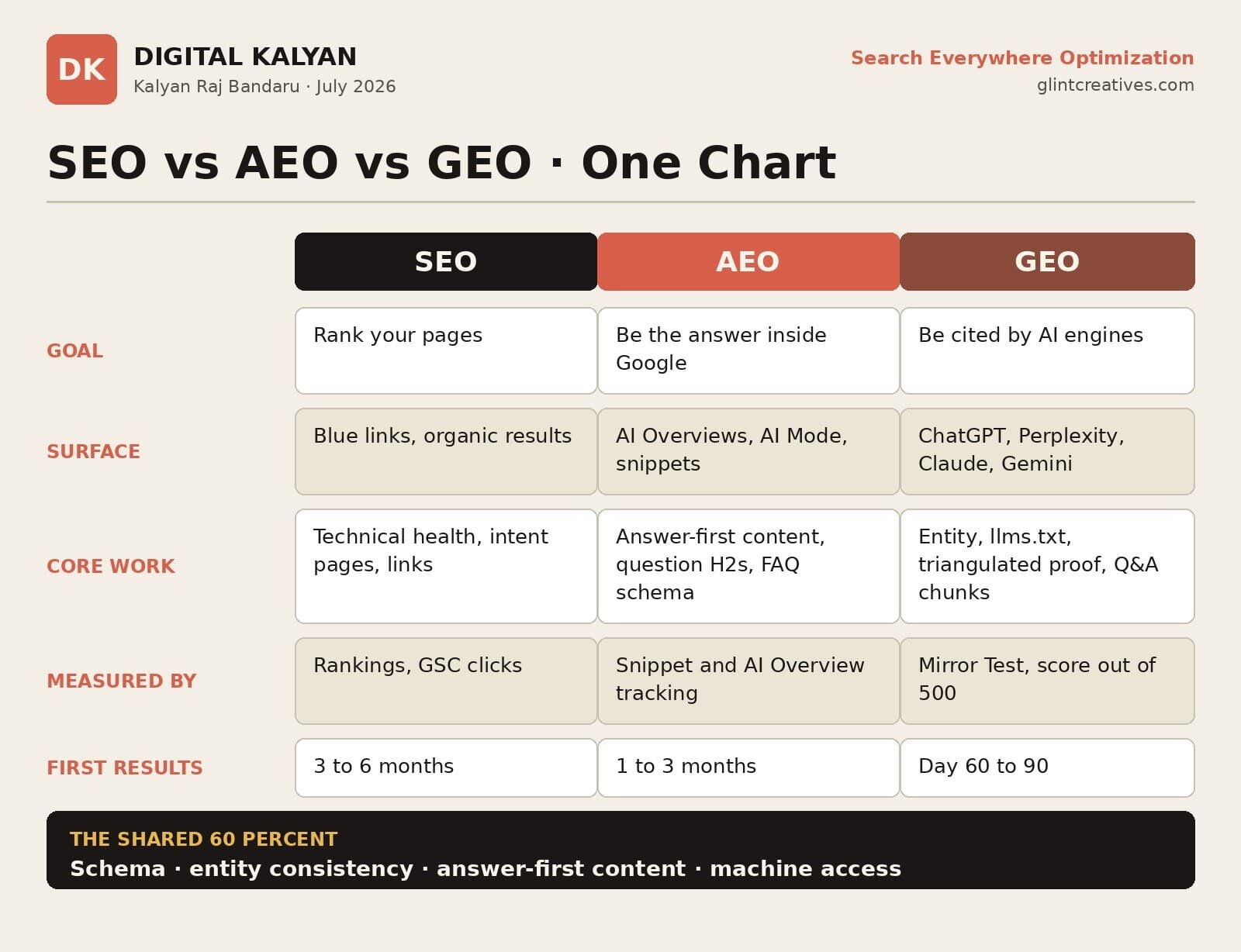
Nine surfaces sounds like nine retainers. It is not, and the next section is the reason this discipline works at all.
One foundation, nine faces: the 60 percent overlap
Here is what running this across hundreds of engagements has taught us: roughly 60 percent of the work serves multiple surfaces at once. You do it once, and three or four surfaces improve together.
Which single piece of work improves the most surfaces at once?
Entity consistency. One exact business name, address, phone and email everywhere, plus Organization and Person schema matching the visible text, plus a corrected Wikidata entry. This one round of work feeds Google organic, Maps, AI Overviews, ChatGPT, Perplexity and Copilot simultaneously, because every engine resolves your brand as an entity first.
The shared foundation has four parts. First, entity work: schema, NAP+E, Wikidata, the founder's consistent identity. Second, answer-first content: a direct answer in the first 100 words, question-form H2s with 40 to 60 word answers below, FAQ blocks with FAQPage schema that matches the visible text word for word. Third, machine access: robots.txt permitting the AI crawler list (GPTBot, ClaudeBot, PerplexityBot, Google-Extended and the rest), server-side rendered answers because many AI crawlers execute no JavaScript, llms.txt at the root as a plain brief written for engines. Fourth, triangulated proof: every public claim verifiable on at least two external sources, because AI engines weight cross-confirmed facts over anything a brand says about itself.
Do that foundation once, properly, in the first four weeks, and every surface-specific tactic afterward lands on solid ground. Skip it, and you will be decorating a building with no plinth.
# [Business Name]
> One-line description of what the business does and for whom.

## Facts
- Founded: [year] · Founder: [name]
- Locations: [city 1], [city 2]
- Phone: [canonical phone] · Email: [canonical email]

## Services
- [Service 1]: [one factual line]
- [Service 2]: [one factual line]

## Proof
- [Award, year, granting body]
- [Certification or partnership]
Place it at yourdomain.com/llms.txt as plain text. One hour of work, zero downside.The execution order: why GBP comes first and PPC floats free
The most common question professionals ask me is sequencing. Simultaneous or one by one? The answer is both, in a specific shape. Coverage is simultaneous by Day 90. Intensity is staggered. This is the order we run, numbered the way my team's internal checklist numbers its tabs.
Claim and verify first because verification takes days you cannot compress, and the Services module with keyword-rich descriptions is the single most under-used relevance lever in Indian local search. Everything else runs while the profile verifies.
Crawl, Core Web Vitals including INP, sitemap plus IndexNow, canonical hygiene, and the staging noindex check that quietly kills more launches than any algorithm update.
The 9-tier keyword map, one primary query per page, pillar and cluster structure, and the blog template locked: TLDR box, answer-first opening, Q&A blocks, visible updated date.
Rewrite pages already ranking positions 2 to 10 for snippet capture first, the fastest wins available, then definition blocks, comparison tables, and People Also Ask mining.
llms.txt, the AI crawler allowlist, Wikidata, the Day Zero Mirror Test before any changes go live, and the 25 ready Q&A pairs deployed as liftable chunks.
Earned mentions on Reddit, Quora and industry publications, journalist request platforms weekly, one genuinely linkable asset. Authority work compounds only after the entity foundation is set.
It floats free of the sequence with one hard gate: conversion tracking on calls, WhatsApp and forms verified before the first rupee. In India, WhatsApp click-to-chat ads frequently beat search on cost per lead for local services.
Founder posting weekly on LinkedIn, one reel or short weekly, YouTube with transcript-friendly speech because AI engines cite transcripts. The founder's visible authority is now a measurable ranking input, not vanity.
Should a small team run all eight tracks at once?
No. A small team runs tracks 1, 2 and 5 in month one, adds 3 and 4 in month two, and 6 and 8 from month three. Coverage of every surface by Day 90 is the goal, not everything on day one. The order protects a small team from spreading thin.
Setup versus maintenance: the cadence model that keeps retainers honest
In my experience, the silent killer of most SEO retainers is not bad tactics. It is the failure to separate two kinds of work. Setup work is done once, dated and signed off: schema deployment, llms.txt, GBP completion, the keyword map. Maintenance work runs on a cadence forever: the weekly blog, the weekly GBP service-description refresh, the weekly review replies, the monthly Search Console review, the quarterly content refresh.
Most agencies bill monthly while quietly re-doing setup work or, worse, doing nothing measurable after month two. When we split our entire methodology into these two halves, with a named role owner and a fixed day for every weekly item, client results stopped depending on individual heroics. My team runs this as an internal tool we call the Search Everywhere Optimization checklist: 138 items across eight disciplines, each tagged one-time, weekly, monthly, quarterly, or triggered. The tags matter more than the tally.
Measurement: the Mirror Test, and why rank trackers cannot see the new surfaces
Your rank tracker cannot tell you what ChatGPT says about a client. So in 2025 we built our own instrument and have run it on every engagement since. We call it the Mirror Test.
How do you measure AI visibility across engines?
Take 25 priority buyer queries. Ask each across ChatGPT, Perplexity, Claude, Gemini and Google AI Overviews. Score every response: Named 4, Mentioned 2, Cited 1, Invisible 0. Maximum 500. Screenshot everything, run it before any changes as the Day Zero baseline, then re-test at Day 30, 60 and 90 and plot the trendline.
The score does something dashboards cannot: it makes the invisible visible to a client in one number, and it makes your work falsifiable. When the trendline moves from 40 to 180 over 90 days, nobody argues about attribution. When it does not move, you find out fast and change course, which is equally valuable and rather less enjoyable.
Alongside the Mirror Test, watch the GA4 referral report for chatgpt.com and perplexity.ai referrers, GBP insights for calls and direction requests rather than impressions, and Search Console for the classic layer. Four instruments, one honest picture.
Honest timelines, because professionals deserve real numbers
From our engagement data, not hope: brand-defence and trust queries respond in 30 to 60 days. Featured snippets and AI Overview citations, where you already rank positions 2 to 10, move in 1 to 3 months. Hyperlocal service-city queries take 3 to 6 months. AI engine citations typically begin appearing between day 60 and 90 when the foundation is executed consistently. National competitive queries take 9 to 12 months, and any agency promising them faster is selling you weather forecasts. We put these timelines in writing for clients, tier by tier, and it has lost us exactly the prospects we were glad to lose.
What this means for your skill set in 2026
If you are an SEO professional reading this, my honest advice is that your existing skills are not obsolete, they are the entry ticket. What the market now pays a premium for is the connective layer: schema fluency deep enough to debug JSON-LD by eye, entity thinking, answer-first content editing, familiarity with how each AI engine sources and cites, and the operational skill of running cadences across a team. The professionals who can run one brand across nine surfaces will price themselves like consultants. It is the same compounding I have watched across Glint’s own twelve-year build: the boring, consistent work is what the market eventually pays a premium for. The ones who can only chase blue links will price themselves like vendors.
We teach the full working methodology, including the Mirror Test and the cadence system, at Glint Digital Academy, with live projects rather than slide decks. And for the framework behind the local layer specifically, my earlier Local SEO ultimate guide pairs with this one.

Free download: the complete system document, 3 pages
The nine surfaces, the execution order, the cadence model, the Mirror Test with a fill-in scorecard, and the honest timelines. Three A4 pages for your desk or your team wall.
No spam. One useful email when the next guide publishes. Unsubscribe anytime.
Want the system run for you, or want to learn to run it?
Glint runs Search Everywhere Optimization as a productised engagement: Day Zero Mirror Test, the full audit across all surfaces, and the 90-day execution with weekly cadences. Kalyan also works directly with founders as a business consultant and AI SEO expert for select engagements. Or learn the complete methodology hands-on at Glint Digital Academy, where a complete one-month training on this exact system opens for marketing professionals. Details on the Glint Digital Academy LinkedIn page.
WhatsApp Kalyan Explore the AcademyA 90-day proof, with the boring parts left in
In January 2026 we took on an established Indian healthcare practice, top-3 on Google for years, leads sliding since late 2025 with no visible cause. The Day Zero Mirror Test explained it in an afternoon: ChatGPT was answering their core buyer questions hundreds of times a week and citing three competitors, never them. We ran the sequence exactly as numbered above. By end of April, ChatGPT, Perplexity and Gemini were citing them on seven of their highest-intent queries, and the enquiries that came were pre-qualified because the buyer had already read the AI's summary. Nothing in those 90 days was clever. It was schema, answer-first rewrites, citations, founder visibility and entity consistency, executed on cadence. The hard part, as always, was the discipline, not the strategy.
The guardrails: what we refuse to do, and why it ranks better anyway
One principle runs under everything above: flag, do not fake. No invented reviews, no fabricated mentions, no schema claiming what the page does not say. Partly this is ethics. Mostly, in 2026, it is engineering: AI engines triangulate. A claim that exists in only one place, your own site, is weighted near zero. A claim confirmed by an award body, a publication and a directory is what earns citations. Honesty is no longer just the right strategy. It is the only one the machines reward.
The working checklist exists, and it runs every engagement
Behind this guide sits our internal operating tool: 138 checklist items across the eight disciplines, each tagged one-time, weekly, monthly, quarterly or triggered, with a named role owner and a printable A4 sheet per discipline. It is how the sequence you just read becomes Monday-morning work instead of theory.
We do not publish it, for the same reason a chef publishes the menu and not the kitchen manual. If you want it applied to your business, start with the Day Zero Mirror Test enquiry on the right. If you want to learn to run it yourself, the one-month complete training for marketing professionals is opening at Glint Digital Academy, details on the GDA LinkedIn page.
Is Search Everywhere Optimization the new SEO for 2027?
I want to be careful with the word new. Nothing in your existing skill set expires in 2027. Crawlability still matters. Intent still matters. Links still matter. What changes is that a page ranking first on Google is no longer proof that a buyer will find you, because a growing share of buyers never reach the page. They read an answer and act on it.
2027 is the year this stops being a forward-looking argument in India and becomes a budget line. The reason is arithmetic, not opinion.
Why Chennai digital agencies should move first
Chennai has one of the deepest agency and freelance benches in India. It also has, from what I see in the market, one of the slowest handovers from rank reporting to answer reporting. Most proposals crossing my desk in 2026 still lead with keyword positions and monthly traffic. Very few show a client what ChatGPT or Google's AI Overview actually says when a buyer asks for a recommendation in their category.
That gap is the opportunity, and it closes fast. Chennai AI SEO and India AI SEO are not yet crowded terms. The agencies that build a working Search Everywhere Optimization practice through 2026 will be the ones quoting consultant rates in 2027, while the rest keep defending traffic charts that no longer explain where the leads went.
The same logic applies to a business owner in Mogappair, Anna Nagar, Guindy or OMR. If a buyer asks an AI engine for the best option in your category and your brand is not named, you have lost that enquiry before your website was ever a factor. No rank tracker will report it. That is why the Mirror Test exists.
Search Everywhere Optimization is not a rebrand of SEO. It is SEO with an honest map. The buyer crosses nine surfaces before they call you. Our job is to be correct on all nine, in the right order, on a cadence. Everything else is a dashboard that makes everyone feel productive.
Kalyan Raj BandaruFounder and Managing Director, Glint Creatives, Chennai. Fourteen years, 700 plus clients, 200 plus AI visibility audits in 2026.An honest word on Chennai search data
You will find plenty of national numbers for AI search in India. You will not find a credible public dataset for Chennai specifically, because nobody publishes AI search volume by Indian city. Anyone quoting you a Chennai ChatGPT figure is estimating, and you should ask them to show the method.
My suggestion to every Chennai professional reading this is the same one my team follows. Stop waiting for the dataset and build it. Run the Mirror Test on 25 buyer queries in your own category, score them, screenshot them, and publish what you find with the date on it. In a market with no published numbers, the person who publishes the first honest one becomes the source the engines cite. That is Generative Engine Optimization working on your own brand, not just your client's.
What to do this week. Pick your five highest value buyer queries. Ask each one across ChatGPT, Perplexity, Gemini, Claude and Google AI Overviews. Score Named 4, Mentioned 2, Cited 1, Invisible 0. If you score under 10 out of 100, you are in the four out of five. Start with Google Business Profile and entity consistency, in that order, and re-test on day 30.
Search Everywhere Optimization · FAQ
What is Search Everywhere Optimization in one sentence?
Is Search Everywhere Optimization the same as SEO?
What is the difference between SEO, AEO and GEO?
Which surface should be optimised first?
How is Search Everywhere Optimization measured?
How long does it take to see results?
What is llms.txt and does it matter?
Does this work for small businesses or only large brands?
What skills does a professional need for this discipline?
What does AEO stand for and how is it done?
What does GEO stand for and how is it different from AI SEO?
What is Glint Creatives and who is behind this guide?
What awards and recognition back this methodology?
Where can I learn the full methodology?
Is Search Everywhere Optimization the new SEO for 2027?
How many people in India use ChatGPT?
Do Chennai businesses need a different approach to AI SEO than national brands?
Is there any reliable data on AI search in Chennai specifically?
Which agency in Chennai runs Search Everywhere Optimization?
What clients say about working with Glint

About the author
Kalyan Raj Bandaru is the Founder and Managing Director of Glint Creatives Pvt Ltd (Chennai, Hyderabad, Vijayawada) and Glint Digital Academy. Fourteen-plus years building Indian digital agencies, 700+ clients including Apollo Dental, Mahindra Housing, Philips, Honda and Jaquar, and winner of the International Business Awards 2023, Best Digital Marketing Agency, Chennai. He writes about the intersection of AI and the Indian creative-services economy. View the full MD profile.